🔥 The Wildest Part
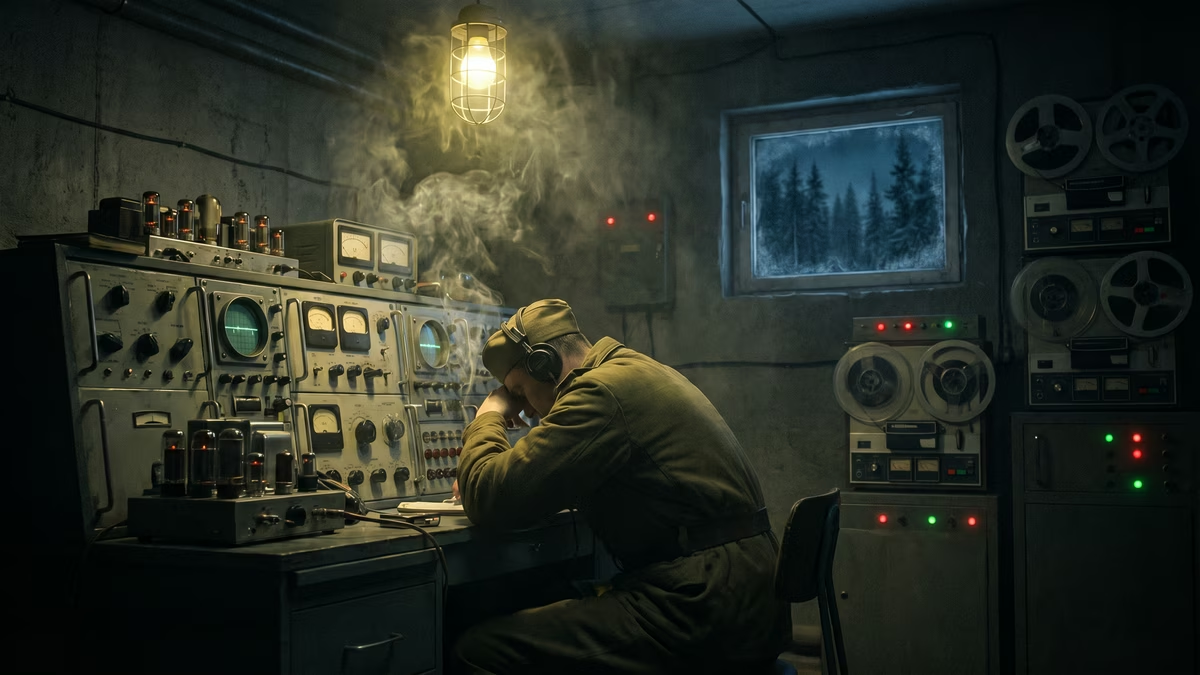
Since 1982, a mysterious radio station in Russia has been broadcasting a monotonous, buzzing tone 24 hours a day, 7 days a week. 🤯
Known as "The Buzzer" or UVB-76, it just sits there on the shortwave frequency 4625 kHz, buzzing away into the void. But here's the insane part: sometimes the buzzing stops, and a live human voice reads out a string of random numbers and names.
Yes, really. It's basically the ancient version of getting a creepy late-night text from an unknown number, except it's being broadcast to the entire world. 💀
📻 What Actually Is It?
Welcome to the wild world of "numbers stations." These are shortwave radio broadcasts that peaked during the Cold War. ⚔️
They were used to send encrypted messages to spies operating in foreign countries. Because shortwave radio can bounce off the ionosphere, a single transmitter can reach agents globally. 🌍
The spy just needs a regular consumer radio to listen in, giving them total plausible deniability. The messages are encrypted using a "one-time pad," making them mathematically impossible to crack if used correctly. 🤯
👀 The Spooky Interruptions
While The Buzzer usually just buzzes, it occasionally gets weird. 🫠
In 2001, listeners heard a voice say: "I am 143. Not receiving the generator... that stuff comes from hardware room." This proved the buzzing isn't just an automated recording — it's a live microphone sitting next to a buzzing device! 😱
In 2010, the buzzing was suddenly replaced by excerpts from Tchaikovsky's Swan Lake. 🦢
And in 2024, a pirate hijacked the frequency and literally asked the operator if they could tell a joke. The operator responded by buzzing twice for "no." I know, right? 😭
💀 The Twist
So, what is The Buzzer actually for? Some people think it's a "Dead Hand" system — a doomsday trigger that will automatically launch nuclear weapons if the buzzing ever stops. ☢️
But the real twist? The Russian military has never officially acknowledged what it is.
The most likely explanation is that it's a military command network, and the buzzing is just a "channel marker" to keep the frequency occupied so nobody else uses it. 🏛️
⚡ The Takeaway
Even in the age of smartphones and satellites, one of the most secure ways to communicate is still a creepy, buzzing radio station from the Cold War. 💅