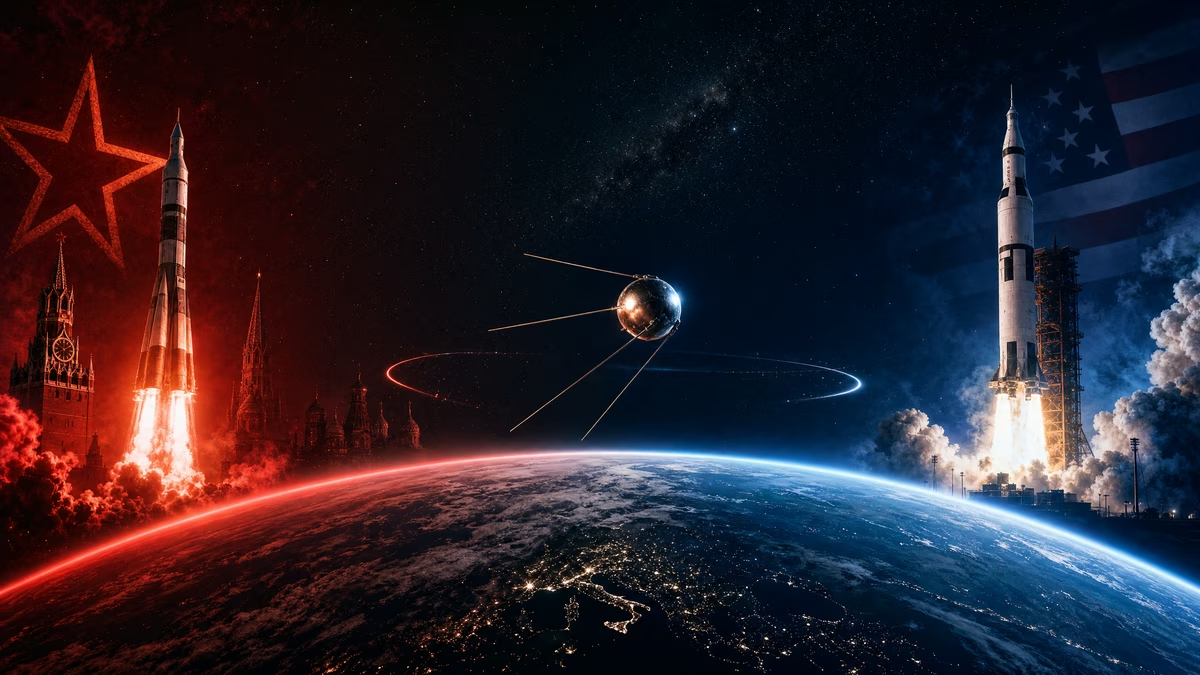
Picture this: a metal beach ball starts beeping over Earth, and suddenly America is staring at the sky like, “Are we about to get nuked from space?” 😱 That was Sputnik in 1957: tiny satellite, massive Cold War panic, instant global main-character energy.
🔥 The Beep Heard Around the World
The Soviet Union launches Sputnik 1, and the vibes are not chill. It’s only about 23 inches wide, but every “beep-beep” sounds like a flex in orbit ⚡.
Ham radio operators could literally tune in and hear Sputnik passing overhead. Imagine your rival posting from space before you even have decent rocket confidence. No way.
The U.S. public panics because if the Soviets can launch a satellite, maybe they can launch something way less cute. Space exploration is suddenly not just science; it’s military dread with a shiny metal soundtrack 👀.
💀 America’s First Reply Was… Embarrassing
America tries to clap back with Vanguard in December 1957. The rocket rises, collapses, and explodes on the launch pad. Not even joking: it becomes basically the ancient version of getting canceled on live TV 🫠.
The press nicknames the failed rocket “Kaputnik.” Brutal. Meanwhile, the Soviets are stacking wins like a propaganda highlight reel.
Then the U.S. finally gets Explorer 1 into orbit in 1958, and yes, it makes real science happen by helping discover the Van Allen radiation belts. A comeback arc begins 🔥.
👑 The Soviets Keep Dropping Firsts
First satellite. First animal in orbit. First human in space. First woman in space. First spacewalk. The Soviet space program is basically yelling “beat that” from orbit ⚔️.
Some moments are inspiring; some are heartbreaking. Laika, the dog aboard Sputnik 2, becomes a symbol of the cost of racing too fast 💔.
Yuri Gagarin’s entire first human spaceflight lasted only 108 minutes. One orbit, worldwide fame, and the U.S. government is immediately sweating through its suit.
Then Valentina Tereshkova becomes the first woman in space in 1963, spending nearly three days in orbit. Iconic. History said “boys only,” and she said “watch me.” 💅
🚀 Kennedy Raises the Stakes
Here’s the insane part: Kennedy commits America to landing a man on the Moon before the decade ends when U.S. astronauts have spent barely 15 minutes total in space 🤯.
Can you imagine? That’s like failing the driving test, then announcing you’re entering Formula 1.
NASA goes full grind mode: Mercury proves humans can survive space, Gemini practices rendezvous and spacewalks, and Apollo becomes the most expensive “don’t embarrass us again” project ever built 🏛️.
🤯 The Twist Nobody Talks About
The Space Race wasn’t really about vibes, flags, or moon dust. It was about proving whose missiles, science, and ideology looked strongest to the entire planet.
The Soviets officially denied they were racing to the Moon, even while secretly chasing it. Bestie, that is peak Cold War behavior.
And while Apollo 11 gets the victory montage in 1969, the rivalry doesn’t just vanish. In 1975, Apollo and Soyuz dock in orbit for the famous “Handshake in Space” 🫱🏽🫲🏼.
From “beat that” to “let’s not destroy Earth,” the plot twist is that space became both the flex and the peace offering.
🔥 The Takeaway
The Cold War Space Race was humanity doing something beautiful for extremely messy reasons: fear, ego, politics, and the terrifying need to win. Wild, right? 🌕
📚 Sources & More Reading
What Was the Space Race? - National Air and Space Museum
Sputnik and The Dawn of the Space Age - NASA History
From Sputnik to Spacewalking: 7 Soviet Space Firsts - HISTORY
Timeline of the Space Race, 1957–69 - Encyclopaedia Britannica