Ferdinand Magellan had crossed the Pacific, made a powerful ally in Cebu, and begun demanding that nearby leaders recognize the Spanish king. It was an impressive run.
Then he met Lapulapu.
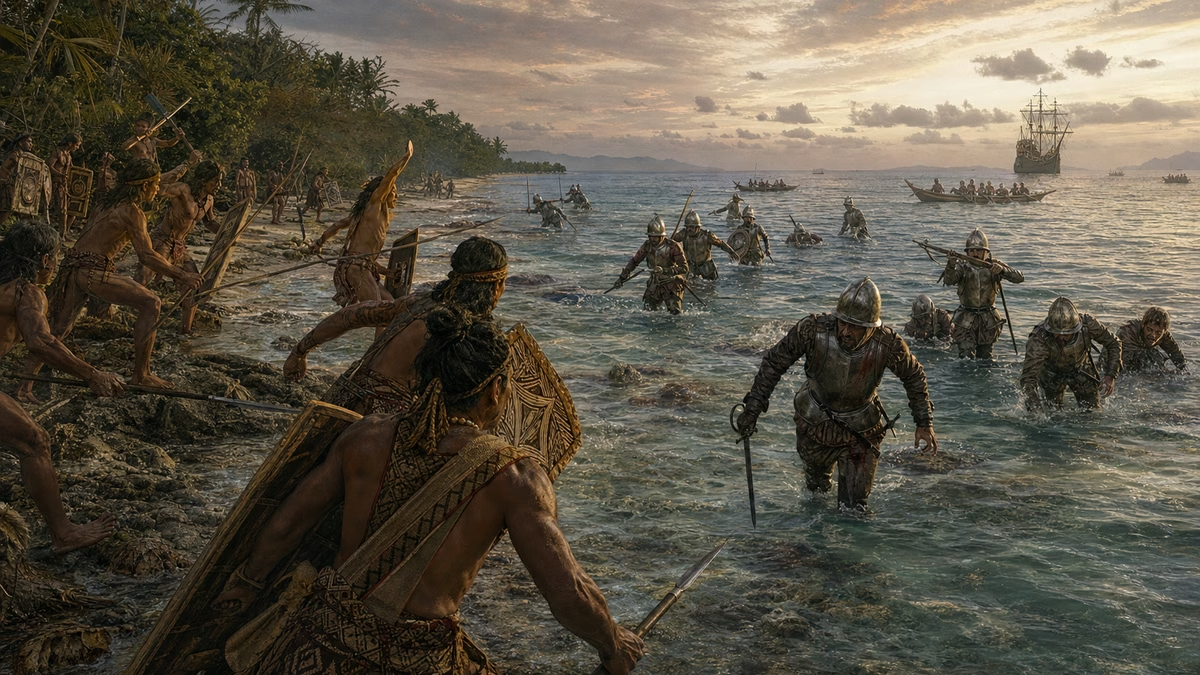
Before sunrise on April 27, 1521, Magellan led roughly fifty armed men into the shallow water off Mactan. His ships could not get close enough to provide useful cannon fire. His soldiers had to wade toward shore while Mactan’s defenders waited on ground they knew.
By the time the survivors reached their boats, Magellan was dead.
The story is often reduced to a heroic duel: Lapulapu versus Magellan, one-on-one, winner takes history. The real event was messier—and more interesting. It involved diplomacy, conversion, local rivalries, an overconfident expedition commander, and one community’s refusal to be pushed around.
Magellan Arrives With Friends—and Expectations
Magellan’s expedition reached the Philippine archipelago in March 1521 while searching for a westward route to the Spice Islands. He was sailing for the Spanish crown, but he had not arrived in empty or politically unorganized territory.
Cebu and Mactan already belonged to a busy maritime world of trade, alliances, rival leaders, and negotiated power. Magellan was entering someone else’s political landscape, even if he did not behave that way for long.
In Cebu, Magellan formed an alliance with Rajah Humabon. There were gifts, ceremonies, displays of European weapons, and a campaign of baptisms. Religion and politics arrived together. Conversion was tied to Magellan’s promises of friendship and protection—and to his expectation that local leaders would recognize the authority of the Spanish king.
Humabon’s alliance also pulled Magellan into a local power struggle. Not every leader on nearby Mactan accepted Humabon’s claimed authority. Lapulapu was one of them.
Mactan Says No
Our main eyewitness is Antonio Pigafetta, a member of Magellan’s expedition. His account comes from the European side, so it cannot tell us exactly what Mactan’s defenders thought or said. But it records the confrontation that pushed Magellan toward battle.
According to Pigafetta, a representative connected to Zula—a Mactan leader aligned with Humabon—reported that Lapulapu would not comply with the demands being made through Magellan’s alliance.
That refusal was more than an insult. Magellan was no longer simply visiting, trading, or preaching. He was attempting to enforce a political arrangement with armed men behind it.
He decided to make an example of Mactan.
The Reef Ruins the Plan
Magellan approached before dawn with a small landing force. On paper, the Europeans had frightening advantages: armor, guns, crossbows, swords, and ships carrying artillery.
Unfortunately for Magellan, ships are much less impressive when a reef keeps them far from the fight.
Pigafetta describes the landing party wading through shallow water toward the island. The expedition’s heavy weapons could not support them effectively from offshore. Every step toward land carried the soldiers farther from their boats and deeper into terrain controlled by Mactan’s defenders.
The number of defenders in Pigafetta’s account is probably an estimate made during a chaotic fight. What matters is that Magellan’s force was badly outnumbered, exposed, and unable to use its biggest advantage.
Armor did not make the Europeans invincible. Firearms did not end the battle instantly. Technology still depended on terrain, distance, timing, and a plan that actually worked.
This one did not.
The Attack Becomes a Retreat
Pigafetta says Magellan’s men burned houses during the attack. Instead of breaking the defenders, the destruction reportedly made them fight harder.
The landing force was surrounded and driven back toward the water. What had begun as a show of authority became a desperate attempt to reach the boats.
Magellan stayed behind with a shrinking group as the others withdrew. Pigafetta describes him being wounded and then overwhelmed in a group assault.
Lapulapu led Mactan’s defense, but the surviving eyewitness account does not securely identify him as the person who delivered the fatal blow. The famous image of Lapulapu personally killing Magellan belongs to later tradition, not firm eyewitness evidence.
He did not need to strike the final blow to win the battle. His community had rejected Magellan’s demands, defeated his landing force, and killed the commander trying to enforce them.
What Mactan’s Victory Did—and Did Not—Mean
The Battle of Mactan was a major victory against Magellan’s attempt to impose Spanish authority. It was not the overthrow of an established Spanish colony.
Spain did not yet have a durable government in the islands. Miguel López de Legazpi established a lasting Spanish settlement in Cebu in 1565—forty-four years after Magellan’s death. Manila became Spain’s principal colonial center in 1571.
Lapulapu was also not fighting in the name of a modern Philippine nation-state. The political world of 1521 was local and regional. Mactan’s leaders, Humabon’s Cebu, Zula’s faction, and Magellan’s expedition all had their own interests.
But none of that makes the victory smaller. It makes it more human.
Lapulapu faced a foreign commander who expected an alliance with one ruler to give him authority over others. Mactan refused. When Magellan tried to turn that refusal into a military lesson, the lesson went the other way.
Why Lapulapu Still Matters
Lapulapu later became a Philippine national symbol of resistance and freedom. That modern meaning grew long after 1521, but it rests on something real: Mactan’s defenders stopped an armed expedition from making its demands stick.
Magellan had survived an ocean crossing that most Europeans could barely imagine. He had navigated storms, hunger, uncertainty, and a passage through the tip of South America that now bears his name.
Then he underestimated a reef, a rival political world, and the people waiting for him on shore.
History remembers the voyage. Mactan remembers where it ended.
Sources & Further Reading
Journal of Magellan’s Voyage — Library of Congress / Yale University Library, World Digital Library collection
Negotiating Empire, Part I: From Magellan to the Founding of Manila, 16th–18th Centuries — Library of Congress
Lapulapu historical marker registry entry — National Historical Commission of the Philippines
Ferdinand Magellan authority record — PARES: Portal de Archivos Españoles, Government of Spain
Pre-Baptismal Instruction and the Administration of Baptism in the Philippines during the Sixteenth Century — The Americas / Cambridge University Press
History of Cebu Province — Province of Cebu