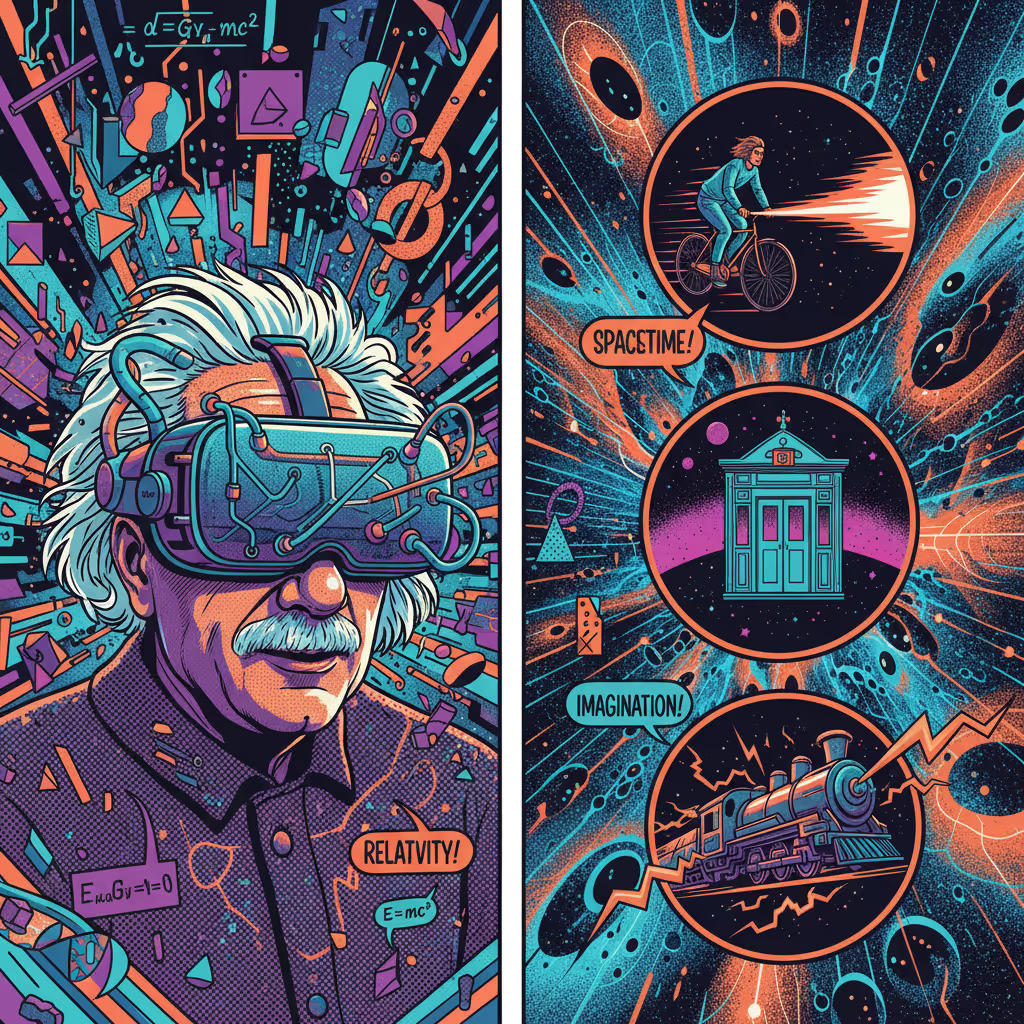
Long before we had the Oculus Rift or Apple Vision Pro, the most powerful virtual reality headset on Earth was located squarely between Albert Einstein's ears. He didn't need a fancy setup to bend the laws of physics; he just needed a comfy chair and his own imagination. He called these mental simulations Gedankenexperimenten (German for "thought experiments"), and they were the secret weapon behind his most revolutionary ideas.
These weren't just daydreams. They were rigorous, logical explorations of the universe, run on the most powerful graphics card known to man: the human brain. Einstein would imagine scenarios that were impossible to create in a lab and ask a simple question: "What would happen if?" The answers led him to tear up the rulebook of classical physics.
Level 1: Chasing a Light Beam
The first-person shooter that broke physics. At just 16 years old, Einstein booted up his first major thought experiment: What would happen if you could run fast enough to catch up to a beam of light?
In his mind, he imagined himself riding alongside a light wave. He reasoned that if he matched its speed, the wave would appear to be frozen in space next to him. But according to the laws of physics at the time, light is an electromagnetic wave that, by definition, has to move. A stationary light wave was a contradiction, a glitch in the matrix. It just couldn't exist.
This paradox haunted him for a decade. If the speed of light was constant and could never be caught, then something else had to give. His conclusion? Time and space themselves weren't fixed. They were relative. This was the foundational idea that led to his Special Theory of Relativity in 1905.
Level 2: The Man in the Elevator
This next thought experiment is a wild ride. Imagine you wake up in a sealed box, like an elevator, floating in deep space. You're weightless. Suddenly, you feel your feet press against the floor. What's happening?
There are two possibilities:
Here's the mind-bending part: from inside the box, there is absolutely no experiment you could perform to tell the difference. The feeling of gravity and the feeling of acceleration are identical. This led Einstein to his Principle of Equivalence: gravity and acceleration are the same thing.
This was a huge leap. If acceleration could bend light and warp space and time (which he already established), and gravity was the same as acceleration, then gravity itself could bend light and warp the very fabric of spacetime. This became a cornerstone of his General Theory of Relativity.
The Ultimate VR Headset
Einstein's thought experiments were more than just clever puzzles. They were a new way of doing science. He showed that the human imagination, when guided by logic and curiosity, could be a laboratory for exploring the deepest secrets of the cosmos.
So the next time you strap on a VR headset to explore a digital world, remember that the most powerful one ever created required no electricity, no downloads, and no updates. It was just a man in a room, asking "What if?" and changing the world forever. 🔥
Sources & More Reading
1.World Economic Forum - "5 of Einstein's thought experiments that changed science"
•A great overview of his most famous Gedankenexperimenten, including the ones that challenged quantum theory. https://www.weforum.org/stories/2016/08/5-of-einsteins-thought-experiments-that-changed-science/
2.Scientific American - "On the Heels of a Light Beam"
•A deep dive into the very first thought experiment Einstein had as a teenager and how it shaped his entire career. https://www.scientificamerican.com/article/on-the-heels-of-a-light-beam1/
3.Einstein Online - "The elevator, the rocket, and gravity"
•An excellent explanation of the equivalence principle and how the elevator thought experiment works. https://www.einstein-online.info/en/spotlight/equivalence_principle/