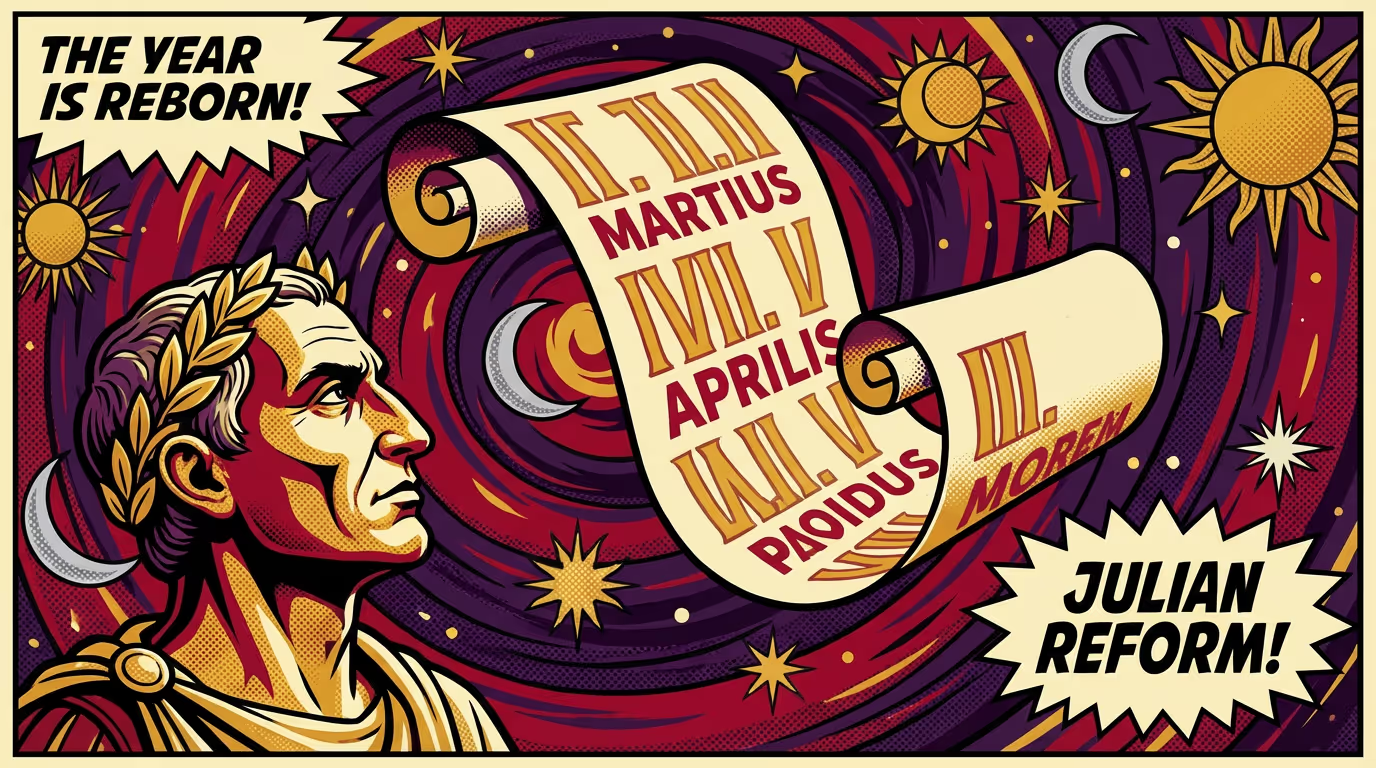
Imagine your birthday drifting so much that it lands in a different season every few years. Or a summer festival happening in the middle of autumn. Sounds like a mess, right? Welcome to the Roman Republic before Julius Caesar. 😅
For centuries, the Roman calendar was a disaster. It was originally a 10-month, 304-day calendar that just... ignored winter. Seriously. The two months when fields were fallow just didn't count. Later, they added January and February to get to 355 days, but that was still 10 days shorter than the actual solar year.
To fix this, the Romans would periodically insert an extra month called Mercedonius. But here's the tea: the decision to add this month was controlled by politicians and priests, the pontiffs. They quickly realized they could abuse this power to mess with time itself.
Need to stay in office a little longer? Just add an extra month!
Want to shorten your political rival's term? Don't add the month!
It was pure chaos. Between 66 and 46 BCE, the calendar drifted a whopping 90 days out of sync with the seasons. The historian Suetonius complained that "the harvest festivals did not come in summer nor those of the vintage in the autumn." Yikes.
Caesar's Epic Fix: The "Year of Confusion"
When Julius Caesar came to power, he knew he had to fix this. While he was in Egypt, he saw their slick, 365-day solar calendar and got inspired. He brought the Greek astronomer Sosigenes of Alexandria back to Rome to help him cook up a solution.
To get the calendar back on track, Caesar had to make 46 BCE the longest year in history. This legendary year, known as the "Year of Confusion," was 445 days long and had 15 months. It was a one-time reset to get Rome back in sync with the sun. ☀️
The Julian Calendar is Born
After the Year of Confusion, the new Julian Calendar kicked off in 45 BCE. It looked a lot like ours:
The calendar featured 365 days in a year, organized into 12 months with 30 or 31 days (except February). A leap year occurred every four years, adding an extra day to February. Caesar also made January 1st the official start of the new year. To honor himself, he renamed the month of Quintilis to July. His successor, Augustus, would later rename Sextilis to August.
So, Why "Mostly"?
Caesar's calendar was a massive upgrade, but it wasn't perfect. Sosigenes had calculated the solar year as 365.25 days, but it's actually 365.2425 days. That's a tiny difference of about 11 minutes per year.
But over centuries, those 11 minutes added up. By the 1500s, the Julian calendar had drifted 10 days off course. This is why in 1582, Pope Gregory XIII introduced the Gregorian calendar—the one we use today. He tweaked the leap year rule (skipping it on century years not divisible by 400) to fix the drift for good.
So next time you check your calendar, give a little nod to Julius Caesar. He may not have gotten it perfect, but he cleaned up one of the biggest messes in history and gave us the system we still live by. 🔥
Sources & More Reading
1. BBC Future - "Why Julius Caesar's Year of Confusion was the longest year in history"
A fantastic deep dive into the pre-Julian calendar chaos and how Caesar created a 445-day year to fix it.
2. TheCollector - "How Julius Caesar Changed Time"
Explores the political manipulation of the old calendar and the Egyptian inspiration behind the Julian reform.
3. Wikipedia - "Julian calendar"
A comprehensive overview of the Julian calendar, its structure, and its eventual replacement by the Gregorian calendar.