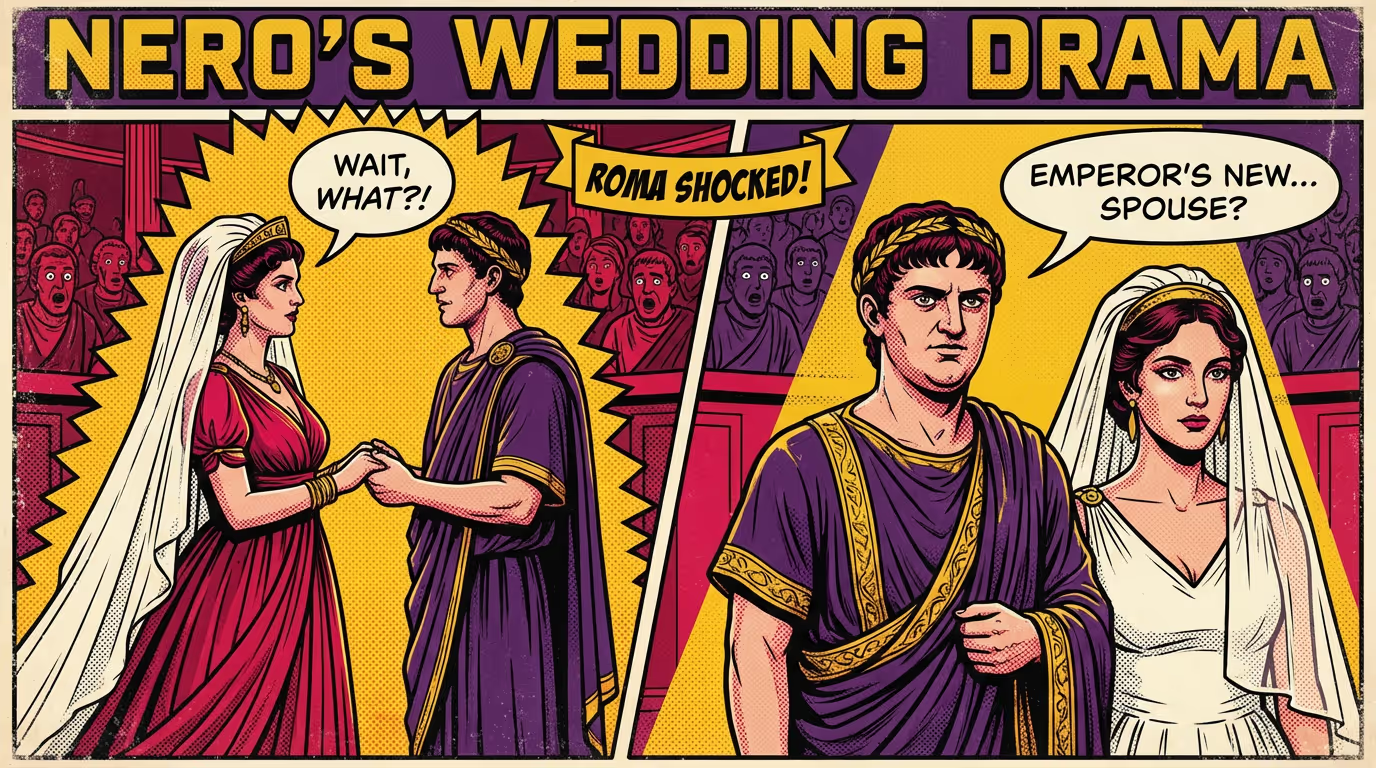
Emperor Nero, the infamous Roman ruler known for his tyranny and extravagance, did something that shocked even the scandal-hardened citizens of ancient Rome: he married two different men in public ceremonies. In one, he was the groom. In the other, he was the bride. 👰
This wasn't just a private affair. These were public spectacles with all the traditional rites: a dowry, a bridal veil, and witnesses. But to understand why this was so scandalous, you have to get one thing straight: ancient Roman sexuality wasn't about who you slept with, but how you did it. It was all about power.
The Rules of Roman Sexuality: It's All About Dominance
In the patriarchal world of ancient Rome, the primary rule of sexuality was the active/dominant vs. passive/submissive dichotomy. A freeborn Roman citizen was expected to be the active, dominant partner in any sexual encounter. Taking the passive role was seen as unmanly and shameful, a sign that you were no better than a slave or a woman.
It was perfectly acceptable for a Roman man to have a same-sex relationship, as long as he was the one in control and his partner was of a lower social status—a slave, a prostitute, or an entertainer. So, same-sex attraction wasn't the issue. The scandal of Nero's marriages was far more complex.
Nero the Groom: The Tragic Story of Sporus
In 67 AD, Nero became infatuated with a young slave boy named Sporus, who reportedly bore a striking resemblance to Nero's deceased wife, Poppaea Sabina (whom Nero himself had allegedly kicked to death). In a horrifying act of cruelty, Nero ordered Sporus to be castrated and then married him in a lavish public ceremony.
Sporus was dressed in the traditional regalia of an empress, complete with a bridal veil and dowry. Nero, taking the role of the groom, paraded his new "wife" around Rome. The historian Cassius Dio wrote that "the Romans as well as others publicly celebrated their wedding."
This was scandalous not because it was a same-sex union, but because of the extreme violence (castration) and the public mockery of a sacred institution. Sporus's tragic story didn't end with Nero. After Nero's suicide, he was passed between other powerful men before taking his own life to avoid being publicly humiliated in a gladiatorial spectacle.
Nero the Bride: The Wedding to Pythagoras
Just a few years earlier, in 64 AD, Nero had another public wedding, this time to a freedman (a former slave) named Pythagoras. But in this ceremony, Nero flipped the script entirely: he took the role of the bride.
The historian Tacitus described the scene with disgust: "The bridal veil was put over the emperor; people saw the witnesses of the ceremony, the wedding dower, the couch and the nuptial torches; everything in a word was plainly visible, which, even when a woman weds, darkness hides."
This was the ultimate transgression. The emperor, the most powerful man in the world, was publicly taking the passive, submissive role of a woman. He was willingly debasing himself in a way that was unthinkable for a Roman citizen, let alone the head of the empire. It was a flagrant rejection of Roman masculinity (virtus) and a profound insult to the established social order.
Why Was It So Shocking? It Wasn't the Gay Part.
So, why did Nero's marriages cause such an uproar? It boils down to a few key points:
1. Violation of Gender Roles: By taking the role of the bride with Pythagoras, Nero was symbolically making himself a woman, an act of supreme degradation in the eyes of Roman society.
2. Mockery of Tradition: The public ceremonies were a blatant parody of the sacred Roman institution of marriage, which was intended for procreation and the continuation of family lines.
3. Abuse of Power: The violent castration of Sporus was a grotesque display of Nero's absolute and unchecked power.
Interestingly, the historian Cassius Dio implies that Nero's scandalous stage performances as an actor and musician were considered even more disgraceful than his marriages to men. For an emperor to perform on stage like a common entertainer was a shocking breach of decorum.
Nero's story is a powerful reminder that ancient Rome was a complex and often contradictory world. While same-sex relationships were a part of life, the rules of power, status, and gender were absolute. By breaking those rules in the most public and dramatic way possible, Nero cemented his legacy as one of history's most notorious and controversial figures. 🔥
Sources & More Reading
1. HistoryExtra - "Sporus: The Roman Boy Who Became Emperor Nero's Castrated Wife"
A detailed account of Nero's relationship with Sporus, the public wedding, and the tragic aftermath.
2. Wikipedia - "Pythagoras (freedman)"
Explores the historical accounts of Nero's marriage to Pythagoras, where Nero took the role of the bride.
3. Wikipedia - "Homosexuality in ancient Rome"
Provides essential context on Roman attitudes toward sexuality, including the active/passive dichotomy and why Nero's actions were so scandalous.